

Written by Sangay Khandu
Bhutan, a country renowned for prioritising Gross National Happiness over Gross Domestic Product, surprised the world in 2008 by transitioning from an absolute monarchy to a constitutional democracy. Now, it has embarked on an equally ambitious endeavour: creating a digital ecosystem in which the interest of citizen empowerment and democratic participation takes precedence over efficiency or surveillance.
The progress has indeed been remarkable. Yet, between this inspiring vision and day-to-day reality lies the so-called “last mile,” a critical gap in which civil society organisations can support the translation of Bhutan’s digital achievements into actual democratic participation.
Bhutan’s journey into digital democracy has been very thoughtful, first building a sound infrastructure of trust. The 2014 Broadband Policy did more than promise Internet access; it created a Universal Service Fund to ensure that even the most remote mountain villages, like Lunana in the extremely harsh north, could participate. It ensured that even a herder in a far remote community enjoyed similar opportunities as a resident of the capital, Thimphu. The policy worked: Bhutan now boasts strong network coverage, even in economically challenging rural areas. The physical infrastructure is in place.
The Architecture of Digital Trust
The Bhutanese leaders knew well that infrastructure alone doesn’t guarantee participation, but trust does. The National Digital Identity Act of 2023 established a system based on Self-Sovereign Identity principles, placing clear control in citizens’ hands.
Imagine a scenario where one could register a birth, apply for a business license, and access health records, all in a day, which was impossible just some years ago. Through the NDI, a citizen authenticates once but chooses what each agency sees. The hospital doesn’t need tax information; neither does the licensing office need health records. The NDI reinvents the relationship between state and citizen: the citizen owns their identity, and the government is just a trusted verifier. As of November 2025, the NDI, on the Ethereum blockchain, connected over 40 government and private services across such key sectors as digitised birth/death registration throughout all the districts.
Policies and Practical Services
Technical achievements depend on a progressive policy bedrock. In 2019, the e-Governance Policy required a “Whole of Government” and “Citizen Centric” approach that established principles like “Digital by Default.” Such groundwork supports tangible services, such as how the biometric liveness verification feature enables elderly people to access their pensions without needing to travel, at the same time, stemming fraud and eliminating a significant burden.
Furthermore, the integrated Citizen Service Portal is structured around “life events” (e.g., having a child, retiring) instead of bureaucratic departments, making services intuitive. Support is available through the portal, chatbots, and a toll-free call centre number 1199 that accommodates varied levels of digital literacy within its limited resources. The government also committed to building capacity, with a digital skilling programme training hundreds of citizens across economic sectors.
The Last Mile: Translating Vision into Lived Reality
Bhutan has developed a progressive and functional digital state. The vision, commitment, and systems are strong. Yet, barriers exist between these successes and inclusive, democratic participation. These are not failures but predictable challenges, and CSOs are uniquely placed to help address.
1. The Digital Confidence Gap
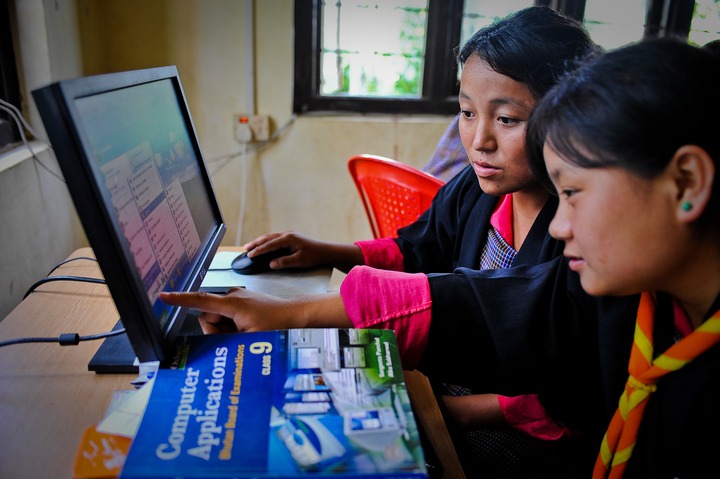
Despite excellent mobile coverage, many rural citizens remain profoundly uncomfortable using it for anything beyond basic calls. The infrastructure exists; the confidence does not.
The government’s skilling programmes are very important, but specific barriers persist. For example, while it is quite correct that the government is committed to ensuring access to services in the national language, Dzongkha, a lot of citizens and older adults have a hard time typing it. They speak fluently but can’t type, creating the linguistic barrier that no amount of network infrastructure can solve. If “digital by default” effectively requires English literacy or advanced typing skills, then it could turn into a mechanism of exclusion.
Some of this gap could be bridged by CSOs through the provision of locally grounded support, building of community trust, and sustained practical help that will transform unsure non-users into capable participants.
2. The Talent Retention Challenge: Brain Drain
Perhaps most insidious is the lack of skilled digital professionals exacerbated by the steady departure of many in search of better opportunities abroad. For the government, this means constant training and difficulty maintaining institutional memory. For CSOs, it means fighting for talent that is already lacking. This “brain drain” slows development in general but also threatens the capacity needed to maintain and evolve Bhutan’s sophisticated systems.
3. The Security and Trust Infrastructure Gap
As CSOs move sensitive operations online, such as managing data, coordinating with vulnerable populations, and facilitating advocacy, new vulnerabilities arise. While the NDI supplies a sound framework for data protection, CSOs lack the resources and expertise to adequately implement cybersecurity. For instance, training staff, conducting security audits, or deploying robust firewalls. When a data breach occurs, it not only compromises operations but also destroys community trust, which is vital for the effectiveness of any CSO. The government built the NDI trust architecture; CSOs need support to build equivalent security in their own operations.
The Essential Role of Civil Society
What the Government of Bhutan is exceptionally good at is building systems and establishing frameworks. Genuine digital democracy in essence, like meaningful citizen engagement and trust with marginalised communities could use more supplementing forces, especially if the objective is to expedite uptake and participation. It requires something more like hyper-local knowledge, deep community trust, and the flexibility to adapt. This is the space for CSOs.
What CSOs Uniquely Provide
CSOs serve as a bridge between policy and practice. Recent successful project-tied collaborations have shown their worth. CSOs often comprehend local barriers better and adapt to realities that government agencies must design for the general case. CSOs can experiment, pilot flexible approaches, learn from failures, and provide the sustained support needed for genuine digital literacy where Government processes are standardised given the scale of plan.
Bridging the Last Mile: Strategic Support for Civil Society
An initial exercise that mapped the “CSOs and Digital Engagement Landscape in Bhutan” in 2024 by the Digital Democracy Initiative was part of a SAARC region study, including Bhutan, aimed at understanding and capturing civic space culture, state of digital inclusion, and Civil Society Organisation operations. The findings based on survey responses from individuals and organisations indicate trends rather than definitive statistics. The findings from the mapping exercise are presented below:
1. Financial Support: Building Sustainable Capacity
Most CSO funding is from short-term, project-tied grants. This makes it impossible to fund the sustained core capacity needed for digital democracy, such as retaining an IT specialist for system maintenance, cybersecurity, and internal training. By providing fellowships or grants funding the position of a Technical Lead within CSOs for at least two years, it could close the gap in the lack of capacity and skills, enabling CSOs to offer stable and competitive salaries, thereby retaining local talent.
2. Non-Financial Support: Specialised Capacity Building
Money needs to be combined with appropriate training tailored for Bhutan’s unique digital ecosystem. Investment into practical training on security protocols, data privacy best practices aligned with the NDI framework, incident response planning, and staff awareness would go a long way. Training could also expand into the ethical and effective utilisation of the NDI and VC within community programmes and explain the system clearly to citizens. Another vital support could be the development of inclusive, Dzongkha-based digital content and training materials that respond to the specific barrier of typing skills.
3. Measuring What Matters: Shifting Metrics
Success metrics have to shift from easy-to-count outputs to meaningful, sustainable outcomes, such as behavioural change and institutional resilience. Instead of just tracking the number of people aware of e-services, track the percentage increase in rural citizens who correctly use e-services independently in Dzongkha. It would also be more effective to monitor CSOs that maintain new capacities, for example, performing regular security audits two years after the initial training, or maintaining their training procedures themselves.
The Path Forward: A Global Model
In Bhutan, something quite remarkable has been achieved: the building of a progressive digital infrastructure anchored on GNH values and democratic participation. This success is the foundation. Now, the hard work lies ahead to ensure these systems reach all citizens, regardless of typing skills or distance. CSOs are critical in this last mile. They transform impressive national infrastructure into actual participation. Strategic support through core funding for retaining technical talent, providing specialized training, and measuring institutional resilience will bridge the gap between policy and practice. If Bhutan succeeds in building a digital democracy that truly serves GNH, inclusive in practice and progressive in vision, it offers a vital model for the world: one where digital transformation strengthens democratic participation and serves cultural values. The final stretch requires sustained and strategic support to ensure the digital path reaches every citizen, hand in hand with civil society.
Как структура сайта влияет на продвижение молодых сайтов?