

Written by Md. Monzurul Alam
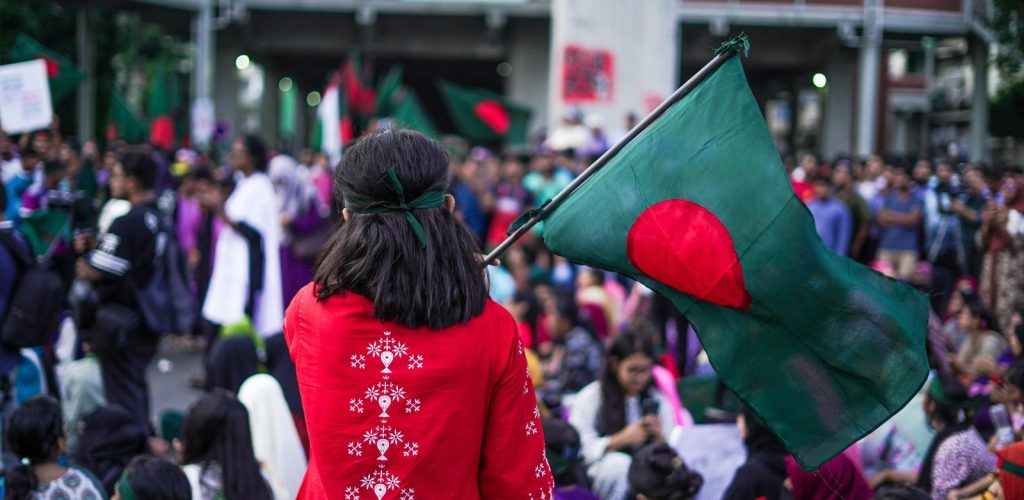
Bangladesh has experienced the emergence of youth and their proactive actions all over the country that brought the shift of political regime, which was assumed to be impossible to break the power of political encompassment. Simultaneously the then political government was becoming more autocratic, and the youth force was turning into action in many formations, including raising their collective voice in national and international platforms, participating in dialogues, and generating knowledge by drafting and developing vlogs, features and podcasts. Their proactive involvement in media mobilisation, especially in the digital platform, got collective attention from the global leaders and policymakers. Very importantly, the young women had a tremendous role in ensuring their digital existence through all of those dimensions.
Last year, during the July uprising, we had seen the government had restricted the internet; sometimes they made an internet blackout and also had severe vigilance of online activists. Despite this, youth found ways to connect: local networks, dorm LANs, messaging apps, face-to-face organising and mobile messaging. Those networking kept them stronger and more adamant in fulfilling their rational demands. The women student played a significant role in carrying out that movement until the end, which ultimately led and boosted protesters and common people to join the movement collectively, and thus the nation at first and the regional and international community supported their rational demand, and finally the then government was bound to flee, leaving their 17 long years of autocracy.
After the political shift, the newly interim government was formed with so many expectations to be filled up. Day after day, the people saw the expectations were not being fulfilled by the interim government, and the frustration became higher as we saw a huge lack of integrity and transparency and accountability of the interim government. It was an expectation from all the citizens that this government will at least ensure the freedom of expression of all people. The more days pass, the more the level of exercising the freedom of opinion and the freedom of expression becomes enshrined, just as in the previous 17 years. Even sometimes it was more severe than in the past. In such a context, the youth mobility, especially the women, became very vulnerable, and their involvement in digital platforms lay in huge risk. Women have been harassed and bullied more in the last year compared to the previous years. We also experienced the rise of ideological groups who were more active in spreading misinformation, disinformation and fake news on online platforms. Sometimes they produced those with their ill intention to create bias among the elderly community who do not have proper digital literacy skills, and thus they believed those hate speeches and disrespected the women's mobility, their freedom and their rights.
During any crisis situation or any unrest, it is always evidenced that the spreading of misinformation and disinformation is higher than in the normal situation. With that point, Bangladesh is facing a severe attack on digital platforms, where sources of information are less likely than the misinformation and disinformation. Therefore, a very limited number of fact-checking sources became busy finding out the authenticity of the proper information. With this process, we saw the women are targeted mostly, and they are being victimised both online and offline. As youth become more active online, new risks emerge. In Bangladesh there is evidence of artificial intelligence, social media manipulation, hate speech and communal conflict being stirred online, and youth often are both victims and actors in this ecosystem. At the same time, there is a lack of a significant government programme to improve digital literacy for all, especially young women. Without basic digital literacy, youth are vulnerable to misinformation, manipulation or exclusion.
To tackle this situation, a collective measure should be adopted where government and non-government actors should intervene, including a massive level of awareness where the inclusion of youth organisations will get the priority, especially their expertise in digital literacy and media mobilisation. The country is like Bangladesh, where thousands of youth organisations are very much active in the promotion of volunteerism with their adequate knowledge, skill and capacity, but they remain blocked due to some administrative processes and policies. For example, there is a clause that determines any organisation willing to work receiving any foreign fund that comes directly to the organisation – in particular, the youth organisations – will not be eligible to receive the fund until they are formally registered under any government entities. The NGO Affairs Bureau, known as NGOAB, is the only authority that provides the registration to any organisation to receive the foreign fund. As the youth organisations have regular connection and connectivity with many global agencies and platforms which either award or allow a minimum funding for implementing small projects, they are mostly unsuccessful, with only the missing of the NGOAB registration proof. This means youth organisations without formal status may be excluded from mainstream grants, may face longer delays, or may not receive funds at all. For youth to feel included as “mainstream citizens” in the democratic ecosystem, this bottleneck needs urgent attention.
Having such complex and multiple challenges and dysfunctional conditions, Bangladesh should concentrate on some key areas to improve and ensure digital rights, and those are as follows:
- Integrate digital literacy (including civic digital skills, media literacy, and safe online behaviour) into the academic curriculum.
- Develop specific programmes for young women’s digital safety and e-civic participation, and ensure gender-responsive online policy frameworks.
- Prioritising food, clothing, shelter, education and health as our basic needs, we should recognise access to meaningful digital participation as a fundamental right in a digital era.
- Simplify the process for youth organisations and CBOs to register for funding, remove unnecessary delays, and create youth-specific funding windows.
- Fund youth-led social enterprises, civic tech start-ups, youth hackathons, and digital democracy platforms to acknowledge youth energy and their talent.
In Bangladesh, youth are not just the “future”; they are a critical force for the present. They have historically stepped up, they are digitally connected, and they are ready to lead. But for youth to fulfil that potential in the digital democracy ecosystem, structural changes are needed in inclusive access to funding, safe and meaningful online spaces, participation pathways in politics, and universal digital literacy. By supporting youth now, especially young women, Bangladesh can build a more inclusive, participatory, resilient democracy for the 21st century.
This piece powerfully captures how Bangladesh’s youth, especially young women, are at the frontline of both democratic struggle and digital vulnerability. The way it connects internet shutdowns, misinformation, and restrictive funding rules with shrinking civic space shows why digital rights must now be treated as a core democratic concern, not a side issue. The concrete recommendations on integrating digital literacy, safeguarding women online, and easing access to funding for youth-led initiatives are timely and actionable steps that policymakers and civil society should urgently prioritise.